
The buyer intent data market has grown fast enough that the real challenge isn’t finding a tool, it’s knowing what a good one actually does. Most platforms compete on signal volume. That’s the wrong metric. What matters is how quickly a detected signal turns into outreach reaching the right decision-maker. A tool that surfaces intent but stops there leaves your team with a research task, not a timing advantage. This covers the criteria that separate useful intent platforms from overcomplicated data products, and how Interceptly is built around all of them.
What Makes a Buyer Intent Data Tool Worth Using
The value of an intent tool isn’t measured by the volume of signals it produces. It’s measured by how quickly and accurately those signals connect to outreach that reaches the right decision-maker. A tool that flags intent but stops there leaves your team with a research task, not a pipeline advantage.
The criteria that separate useful intent platforms come down to signal quality, ICP filtering accuracy, contact data integration, and the speed at which a detected signal becomes an active outreach sequence. Interceptly’s buyer intent data is built around all 4 of these criteria.
The Criteria That Matter Most When Evaluating Intent Tools
Most buyer intent tools are evaluated on the breadth of their signal coverage. That’s a reasonable starting point, but it’s not the criterion that drives outbound results. The 5 criteria below reflect what actually separates high-performing intent platforms from those that add complexity without improving pipeline.
Signal Quality and Source Breadth
Intent signals are only as reliable as the sources they’re drawn from. Platforms that pull from a narrow range of sources produce a distorted picture of actual buying behavior. Look for tools that track signals across topic research, content consumption, third-party publications, and review platforms, and that apply a threshold model so accounts are only surfaced when consistent behavioral patterns emerge rather than a single data point.
Interceptly tracks behavioral intent signals across the web, surfacing in-market accounts based on sustained research activity. A single visit or interaction doesn’t surface an account. Consistent behavior over time does.
ICP Filtering and Account Matching
A raw intent signal has no practical value unless it maps to an account your solution can serve. Effective intent tools apply your ICP criteria automatically, filtering intent signals by industry, company size, geography, and seniority before surfacing accounts for outreach. This is where many platforms fall short: they surface intent without context, leaving your team to assess fit manually before acting.
Interceptly matches intent signals against your ICP criteria in real time, so every account surfaced is both showing buying behavior and meeting your qualification threshold. The result is a shortlist of high-confidence opportunities, not a broad list requiring manual review.
Verified Contact Data Without Manual Research
Company-level intent signals are only half the picture. Getting to the right person inside that account is the other half, and most intent platforms don’t help with it. Tools that surface company-level signals without attaching contact data require your team to research decision-makers independently, which introduces delay and reduces the timing advantage that intent data is supposed to create.
Interceptly connects intent signals to verified contact data automatically using a 700 million record lead database and email finder software. Decision-maker names, titles, and contact details are attached to each surfaced account without any manual lookup required.
Direct Connection to Outreach Execution
The most common failure point in intent-based prospecting is the gap between signal detection and outreach launch. Platforms that require data export, CRM upload, and manual sequence enrollment introduce delays that erode the timing advantage entirely.
Interceptly links detected intent signals directly to multi-channel sequences, enrolling matched accounts into coordinated email, professional social, and phone outreach automatically. The AI sales engagement platform handles personalization at scale so outreach reflects the account and contact, not a generic template. Signal detected. Outreach launched. No gap.
Competitor Intent as a Separate Signal Layer
Third-party intent data tells you a company is researching your category. Competitor intent data tells you they’re already evaluating a specific vendor. These are different signals with different urgency levels, and the best intent platforms treat them separately.
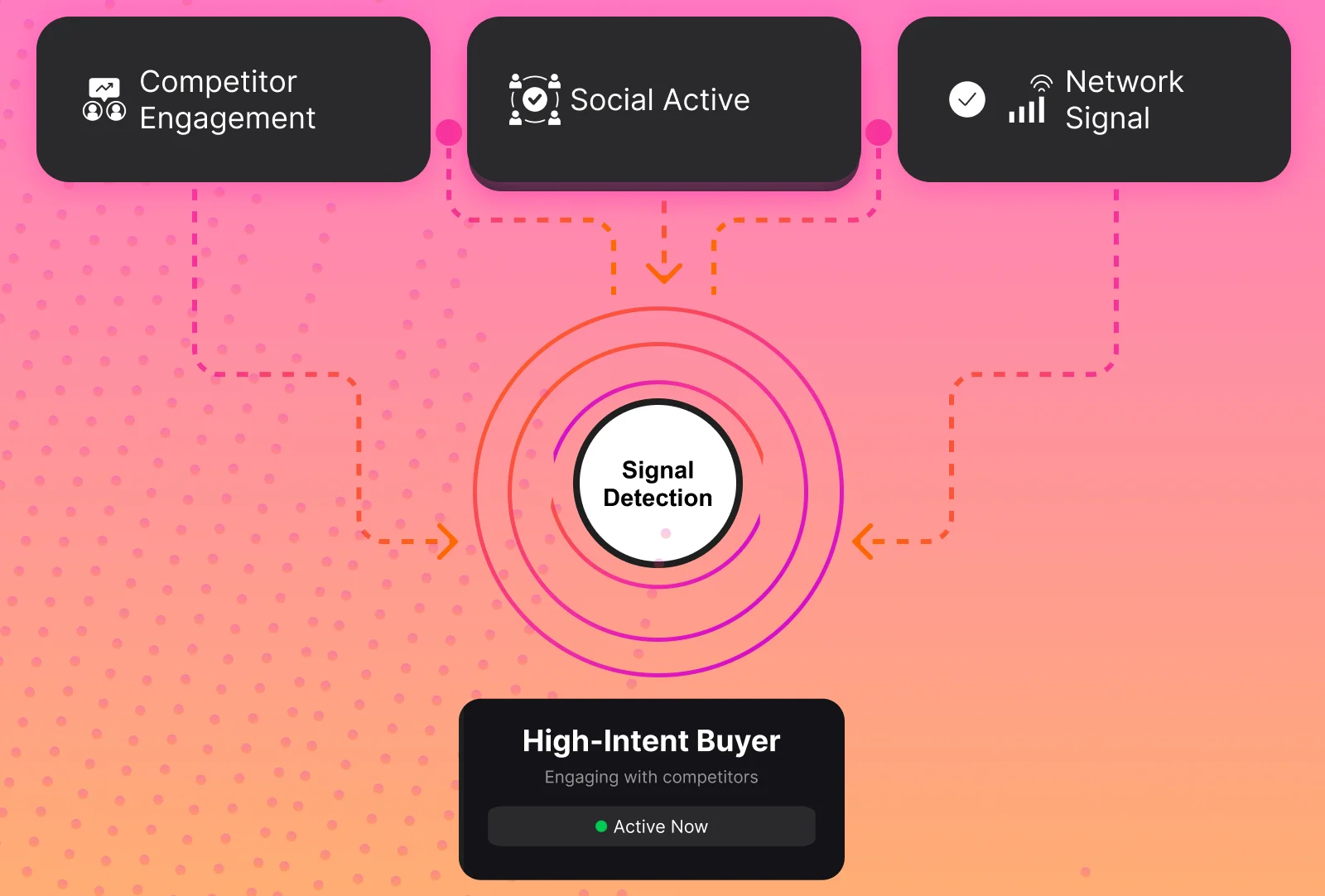
Interceptly’s Signilio™ competitor intelligence surfaces accounts actively engaging with competitor content, campaigns, and profiles as a distinct signal layer. For competitive markets, this is the highest-value use of intent data available. A prospect shortlisting your competitors needs to hear from you now, not next week.
How Interceptly Combines All 5 Criteria in One Platform
Most intent data tools address one or 2 of the criteria above and leave the rest to manual process or third-party integrations.
Interceptly covers all 5. Buyer intent signals are tracked across the web and filtered against your ICP automatically. Verified contact data is attached without manual research. Competitor engagement is surfaced separately through Signilio™. Outreach launches directly from the platform the moment a signal meets your threshold, with no export, no data transfer, and no delay. The unified inbox consolidates all replies across every active channel into one view, so your team manages responses without switching between tools.
Find In-Market Buyers Faster
Interceptly’s buyer intent data identifies in-market accounts, attaches verified contact data, and launches outreach automatically. If your team is working from cold lists while buyers research your category, that’s pipeline going to competitors. Book a demo to see how it works for your ICP.